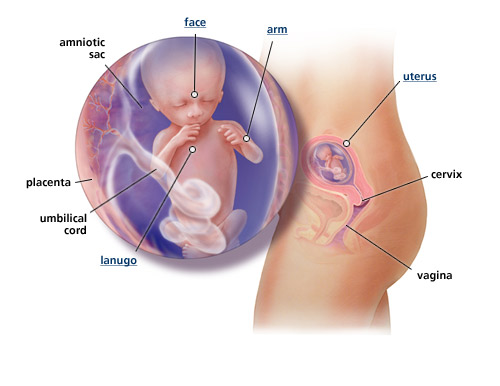
You are now 14 weeks pregnant, which is the beginning of week 15.
Your baby measures about 12 cm long (or 4.7 inches) from head to toe and weighs approximately 85 grams (or 3 ounces).
If your caregiver has an electronic Doppler, they may be able to listen to your baby's heartbeat now.
Your baby's placenta is now fully functional but remains larger than the baby (until about 16 weeks). The placenta supplies your baby with oxygen, fats, proteins, vitamins and minerals as well as removing carbon dioxide and waste materials, by filtering them through the placental tissues attached to the uterus. This intricate process of diffusion makes these exchanges possible because the tiny blood vessels of mother and baby are incredibly close together, yet remarkably always separate.
The placenta is not a barrier, as once thought. It allows most substances in the mother's blood stream to cross over into the baby's blood stream. These include alcohol, nicotine, caffeine, natural remedies, medications, drugs and viruses, possibly affecting the baby's growth and development (depending on what stage the pregnancy is at).
Physical changes
Your baby's placenta now produces most of the pregnancy hormones, in particular progesterone, which is responsible for many common physical changes during pregnancy. These include increased skin pigmentation, lowering the blood pressure, increasing constipation and possibly causing bleeding gums or nose bleeds.
Metallic taste
Some women complain of different taste sensations during pregnancy, particularly a metallic-type taste. This physical change is not often formally recognised by medical caregivers. However, natural therapists believe it could be the body releasing toxins through the lymphatic system (your lymph glands transport and produce your body's defence mechanisms against infection). Others believe it is the body's reaction to being run down with stress, or the result of more physical demands being placed on a woman's body during pregnancy.
Cravings
Many women talk about having weird and wonderful food cravings during pregnancy. These are very normal and may come and go, lasting for a few days to a few weeks, or longer.
Emotional reactions
Pregnancy involves changes in a woman's sexuality as much as it does her body and emotions. Changes may also be apparent in your partner's sexuality and the way they perceive your body and the growing baby. How you and your partner feel about these changes, and how you feel about making love together, can affect your relationship. Depending on your expectations, your individual feelings may deepen your relationship, or in some cases place an added strain on it.
For a few women, pregnancy brings feelings of depression, which may be something that has continued from before the pregnancy, or perhaps being felt for the first time while pregnant. Antenatal depression is becoming much more recognised these days.
Your pregnancy - Week 14
Products
Happix Premium Mini
Happix Premium Midi
Happix Premium Maxi
Happix Premium Junior
Products
Happix Premium Mini
Happix Premium Midi
Happix Premium Maxi
Happix Premium Junior
Products
Happix Premium Mini
Happix Premium Midi
Happix Premium Maxi
Happix Premium Junior