Your pregnancy - week 8
At 8 weeks of pregnancy (or 42 days after conception) you are now at the beginning of week 9.
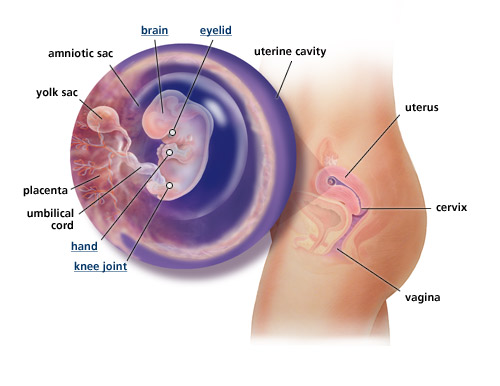
Your baby has grown to measure 1.5 cm (0.6 inches) and their head is now more rounded, making up about 25% of their entire body.
Your baby's face is becoming recognisably human. Their cheeks, mouth, lips and chin are more defined and they now have nasal passages creating the tip of their nose. Your baby develops eyelids this week, which remain fused (closed) until they reach 24 weeks of development.
The internal and external parts of your baby's ears begin to form, including their middle ear, which is responsible for their hearing and balance. However, your baby will not be able to hear sounds until sometime between 19 to 24 weeks. Your baby now has immature taste buds on their tongue and under their smooth translucent skin, many tiny blood vessels can be seen networking through their body.
Your baby's skeleton is starting to form and their arms and legs are longer, extending forwards and across their body, appearing slightly bent. Your baby's hands and feet now have 5 ridges on each, separated by narrow grooves, making them appear webbed.
Did you know? To form separate fingers and toes, the webbing between them undergoes degeneration, or the dying off of cells. This is part of your baby's normal programming that allows the sculpturing of their body parts. For a baby's normal development to unfold, both cell growth and cell death are necessary. A supreme adaptation of nature!
Physical changes
Nose bleeds
It is common for pregnant women to experience sudden nose bleeds. This is due to increased progesterone hormone, making the tiny blood vessels (called capillaries) in the nasal passages dilate and become fuller, as well as increased blood circulating the body (up to 50% more). Your nose may also produce more mucus and feel blocked or stuffy. You may also notice you suffer from allergy and/or sinus problems more readily and colds may be more difficult to recover from.
Bleeding gums
An increase in blood volume and pregnancy hormones can also make your gums bleed at times, which is a normal. This should improve after your baby is born. It is important to look after your teeth and have a dental check-up, especially if your gums become sore and inflamed.
Emotional reactions
Your emotions may still feel very up and down or perhaps they have begun to level out. If you find your emotions are still erratic, make sure you rest and nurture yourself to help support you at this time. Talking with your partner or someone you trust may also help you feel less isolated with your feelings.
Sometimes talking to another mum-to-be can help, or listening to their advice.
Your pregnancy - week 8
At 8 weeks of pregnancy (or 42 days after conception) you are now at the beginning of week 9.
Your baby has grown to measure 1.5 cm (0.6 inches) and their head is now more rounded, making up about 25% of their entire body.
Your baby's face is becoming recognisably human. Their cheeks, mouth, lips and chin are more defined and they now have nasal passages creating the tip of their nose. Your baby develops eyelids this week, which remain fused (closed) until they reach 24 weeks of development.
The internal and external parts of your baby's ears begin to form, including their middle ear, which is responsible for their hearing and balance. However, your baby will not be able to hear sounds until sometime between 19 to 24 weeks. Your baby now has immature taste buds on their tongue and under their smooth translucent skin, many tiny blood vessels can be seen networking through their body.
Your baby's skeleton is starting to form and their arms and legs are longer, extending forwards and across their body, appearing slightly bent. Your baby's hands and feet now have 5 ridges on each, separated by narrow grooves, making them appear webbed.
Did you know? To form separate fingers and toes, the webbing between them undergoes degeneration, or the dying off of cells. This is part of your baby's normal programming that allows the sculpturing of their body parts. For a baby's normal development to unfold, both cell growth and cell death are necessary. A supreme adaptation of nature!
Physical changes
Nose bleeds
It is common for pregnant women to experience sudden nose bleeds. This is due to increased progesterone hormone, making the tiny blood vessels (called capillaries) in the nasal passages dilate and become fuller, as well as increased blood circulating the body (up to 50% more). Your nose may also produce more mucus and feel blocked or stuffy. You may also notice you suffer from allergy and/or sinus problems more readily and colds may be more difficult to recover from.
Bleeding gums
An increase in blood volume and pregnancy hormones can also make your gums bleed at times, which is a normal. This should improve after your baby is born. It is important to look after your teeth and have a dental check-up, especially if your gums become sore and inflamed.
Emotional reactions
Your emotions may still feel very up and down or perhaps they have begun to level out. If you find your emotions are still erratic, make sure you rest and nurture yourself to help support you at this time. Talking with your partner or someone you trust may also help you feel less isolated with your feelings.
Sometimes talking to another mum-to-be can help, or listening to their advice.
Your pregnancy - week 8
At 8 weeks of pregnancy (or 42 days after conception) you are now at the beginning of week 9.
Your baby has grown to measure 1.5 cm (0.6 inches) and their head is now more rounded, making up about 25% of their entire body.
Your baby's face is becoming recognisably human. Their cheeks, mouth, lips and chin are more defined and they now have nasal passages creating the tip of their nose. Your baby develops eyelids this week, which remain fused (closed) until they reach 24 weeks of development.
The internal and external parts of your baby's ears begin to form, including their middle ear, which is responsible for their hearing and balance. However, your baby will not be able to hear sounds until sometime between 19 to 24 weeks. Your baby now has immature taste buds on their tongue and under their smooth translucent skin, many tiny blood vessels can be seen networking through their body.
Your baby's skeleton is starting to form and their arms and legs are longer, extending forwards and across their body, appearing slightly bent. Your baby's hands and feet now have 5 ridges on each, separated by narrow grooves, making them appear webbed.
Did you know? To form separate fingers and toes, the webbing between them undergoes degeneration, or the dying off of cells. This is part of your baby's normal programming that allows the sculpturing of their body parts. For a baby's normal development to unfold, both cell growth and cell death are necessary. A supreme adaptation of nature!
Physical changes
Nose bleeds
It is common for pregnant women to experience sudden nose bleeds. This is due to increased progesterone hormone, making the tiny blood vessels (called capillaries) in the nasal passages dilate and become fuller, as well as increased blood circulating the body (up to 50% more). Your nose may also produce more mucus and feel blocked or stuffy. You may also notice you suffer from allergy and/or sinus problems more readily and colds may be more difficult to recover from.
Bleeding gums
An increase in blood volume and pregnancy hormones can also make your gums bleed at times, which is a normal. This should improve after your baby is born. It is important to look after your teeth and have a dental check-up, especially if your gums become sore and inflamed.
Emotional reactions
Your emotions may still feel very up and down or perhaps they have begun to level out. If you find your emotions are still erratic, make sure you rest and nurture yourself to help support you at this time. Talking with your partner or someone you trust may also help you feel less isolated with your feelings.
Sometimes talking to another mum-to-be can help, or listening to their advice.
At 8 weeks of pregnancy (or 42 days after conception) you are now at the beginning of week 9.
Your baby has grown to measure 1.5 cm (0.6 inches) and their head is now more rounded, making up about 25% of their entire body.
Your baby's face is becoming recognisably human. Their cheeks, mouth, lips and chin are more defined and they now have nasal passages creating the tip of their nose. Your baby develops eyelids this week, which remain fused (closed) until they reach 24 weeks of development.
The internal and external parts of your baby's ears begin to form, including their middle ear, which is responsible for their hearing and balance. However, your baby will not be able to hear sounds until sometime between 19 to 24 weeks. Your baby now has immature taste buds on their tongue and under their smooth translucent skin, many tiny blood vessels can be seen networking through their body.
Your baby's skeleton is starting to form and their arms and legs are longer, extending forwards and across their body, appearing slightly bent. Your baby's hands and feet now have 5 ridges on each, separated by narrow grooves, making them appear webbed.
Did you know? To form separate fingers and toes, the webbing between them undergoes degeneration, or the dying off of cells. This is part of your baby's normal programming that allows the sculpturing of their body parts. For a baby's normal development to unfold, both cell growth and cell death are necessary. A supreme adaptation of nature!
Physical changes
Nose bleeds
It is common for pregnant women to experience sudden nose bleeds. This is due to increased progesterone hormone, making the tiny blood vessels (called capillaries) in the nasal passages dilate and become fuller, as well as increased blood circulating the body (up to 50% more). Your nose may also produce more mucus and feel blocked or stuffy. You may also notice you suffer from allergy and/or sinus problems more readily and colds may be more difficult to recover from.
Bleeding gums
An increase in blood volume and pregnancy hormones can also make your gums bleed at times, which is a normal. This should improve after your baby is born. It is important to look after your teeth and have a dental check-up, especially if your gums become sore and inflamed.
Emotional reactions
Your emotions may still feel very up and down or perhaps they have begun to level out. If you find your emotions are still erratic, make sure you rest and nurture yourself to help support you at this time. Talking with your partner or someone you trust may also help you feel less isolated with your feelings.
Sometimes talking to another mum-to-be can help, or listening to their advice.
Your pregnancy - Week 8
Products
Happix Premium Mini
Happix Premium Midi
Happix Premium Maxi
Happix Premium Junior
Pregnancy
Prenatal Care
First Trimester
Second Trimester
Third Trimester
Pregnancy Problems
Pregnancy Safety&Care
Birth
Pre Labour
Induction of Labour
Stages of Labour
Caesarean Birth
Normal Birthr
Baby
Newborn Baby List
Newborn Needs and Care
Feeding Your Baby
Baby Development
Parenting
Becoming a Parent
Being a Positive Parent