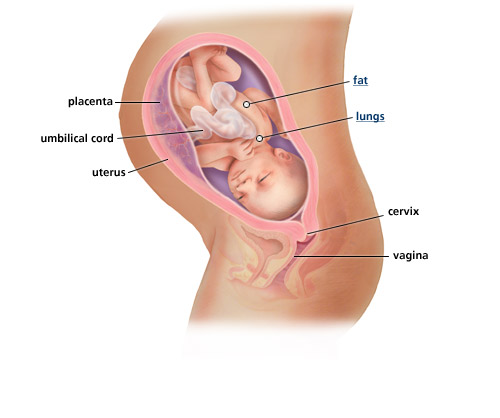
You are now 34 weeks pregnant, which is the beginning of week 35.
Your baby has grown to be about 46 cm long (18.1inches) and approximately 2,350 grams in weight (2.35 kg or 5lb 3oz).
During the next 6 weeks or so, your baby's main task is to gain weight and grow a little larger, as well as build their immune system, which is obtained from you passing blood antibodies through the placenta.
Babies born around 34 to 35 weeks normally fair quite well, but are still regarded as 'mildly preterm', generally requiring some time in the intensive care nursery. This could be for observation, monitoring, possibly small amounts of oxygen for a few hours (or days), obtaining warmth in a humidicrib and perhaps nourishment from a drip in their vein and/or milk feeds down a tube into their stomach.
Physical changes
Varicose veins
These appear when the blood in the veins of the legs pools, making the veins swell into purple/blue bulges. Increased progesterone hormones weaken the walls of the veins, along with pressure and weight on the lower body from the growing baby, especially if this is not your first baby.
Varicose veins of the vulva
Vulval varicosities are swellings of the outer lips of the genitals. They are caused by blood pooling in the veins, making them swell, similar to varicose veins of the legs. Vulval varicosities can make the genitals ache and feel sore and very full. They do not cause problems for the birth process and should disappear a few days after your baby is born.
Emotional reactions
At some point during pregnancy most women wonder whether their baby is normal. They may also consider what they would do if something were wrong. These feelings may be instinctive, possibly relating to unexplainable thoughts like "Do I deserve a healthy baby?" Or there may be concrete reasons such as disorders that run in the family.
Preparing for birth
Fast births
For some women, the labour and birth process can be unusually rapid. Fast labours tend to be more common for second or subsequent babies, but can occasionally happen for first time mothers as well. If labour is being induced, then it is not uncommon for it to be quicker than normal, especially if the woman's body is very sensitive to the medications being used.
2nd stage of labour
Overview
The second stage of labour begins when the woman's cervix is fully open and your baby's head moves down out of the uterus and into the birth canal, ending with the birth of your baby. However, 2nd stage can be made up of four different phases, with their own individual characteristics - resting, active, crowning and birthing phases..
Emotions
The 2nd stage emotionally affects women in different ways. Many feel active and energised, some experience relief and excitement and others feel exhausted and frustrated, or perhaps even overwhelmed.
2nd stage variations
For most women the 2nd stage is uncomplicated. However as with the 1st stage, this phase can also deviate from the norm at any point.
What to expect from your caregiver
Moving from 1st stage into 2nd stage of labour may be detected by your caregiver doing a vaginal examination, or recognising the change by the way that you grunt, moan or push (it is not essential to have an examination unless your caregiver is concerned there might be problems).
Your pregnancy - Week 34
Products
Happix Premium Mini
Happix Premium Midi
Happix Premium Maxi
Happix Premium Junior